A clear owner
See where a request is, who needs to act and what is holding it up.
In the handoff
A map of the current process and its exceptions
Business agents and workflow automation
Move a defined task from intake to a verified result.
For teams losing time to repeated handoffs, copying and exception handling.
01 / The task
Requests arrive in several places, records drift between tools, and nobody can see which cases need attention.
Start with a real example of the work. We can then decide what needs a better process, a clearer interface or a focused build.
02 / A useful result
Agree the scope and acceptance checks before implementation. These are possible outputs, shaped around your task.
See where a request is, who needs to act and what is holding it up.
A map of the current process and its exceptions
Check missing information and repeated events before they create more work.
A scoped workflow with agreed integrations and duplicate checks
Give exceptions a review path instead of quietly dropping them.
A review queue, failure states and a manual recovery path
03 / A possible approach
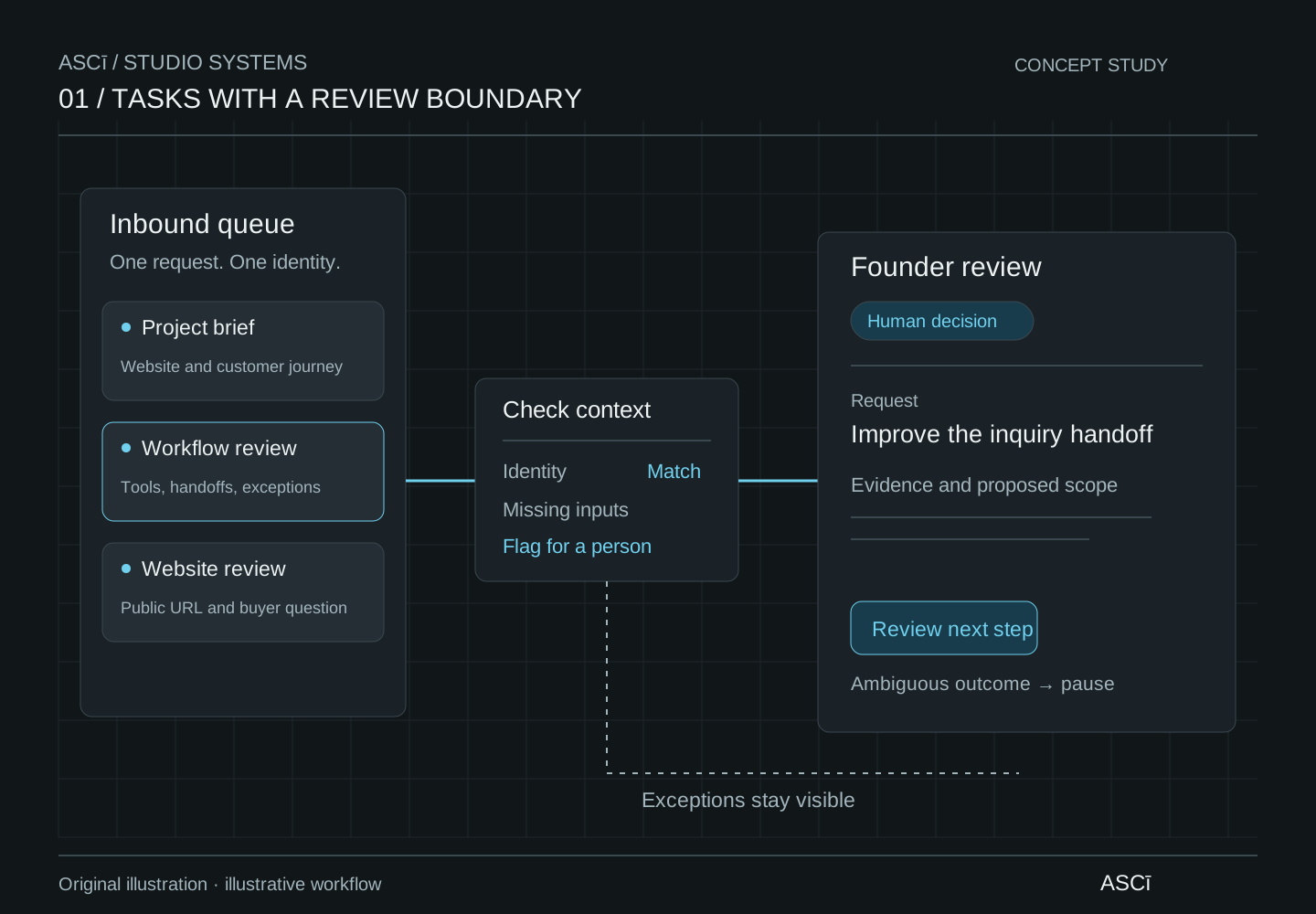
Illustrative scenario. Scope and results depend on the actual process and systems.
A project inquiry can be captured once, checked for missing details and routed to an owner. A person reviews the response before any unapproved communication.
Try the synthetic workflow ↗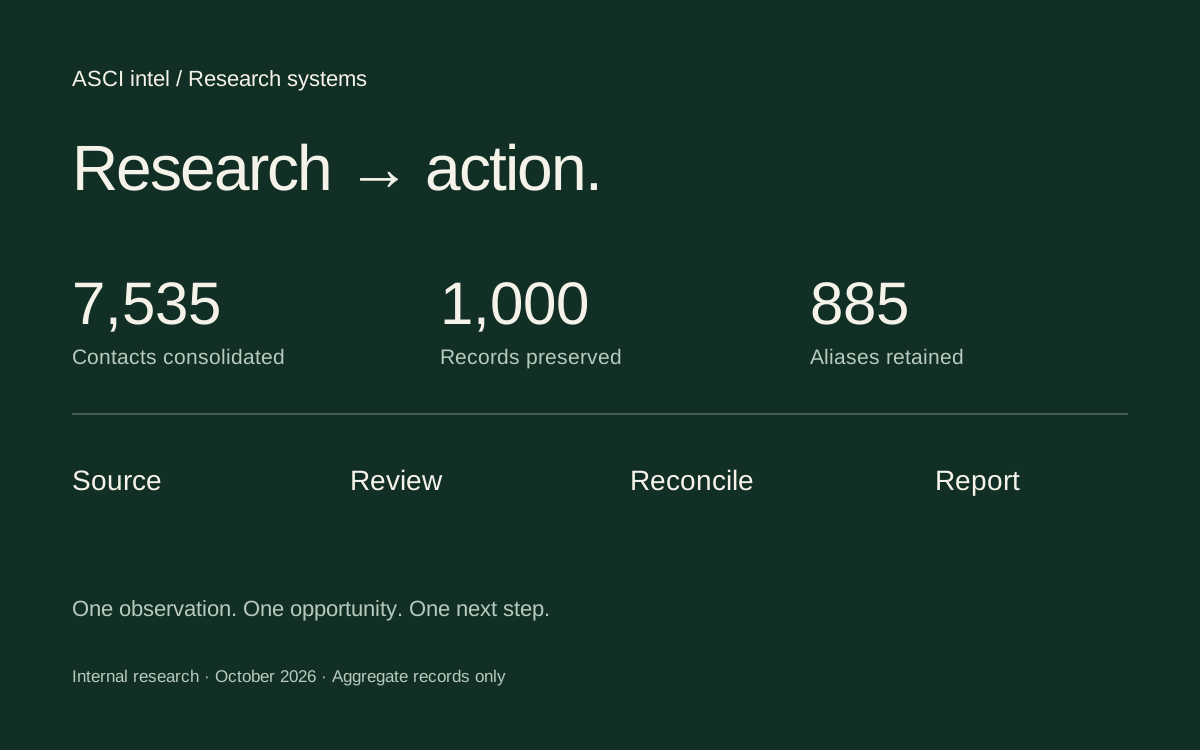
Selected work / Scope matters
Our internal research system distinguishes source records, reconciled contacts and confirmed activity. This is studio work, not a client automation result.
Explore the internal system ↗04 / Working together
Scope, ownership, external costs and review points are agreed before work begins. A focused assessment can precede a build.
A walkthrough with the process owner, representative cases and only the access needed for the agreed task.
A defined task and agreed acceptance criteriaBuild the smallest useful path between the existing tools. Make permissions, approval points and exceptions visible before adding more autonomy.
A focused implementation or testable proposalWe test normal, duplicate, missing-information and failure cases against agreed outcomes. The owner decides which actions require approval.
A workflow map, tested cases, owner queue and documented recovery steps.We document ownership, operation and recovery. Continuing support or team enablement is agreed separately when needed.
05 / Before we begin
Only when the exact action and authority have been agreed and verified. The default is a person reviewing external communication.
Often, yes. We inspect the available integrations, permissions and export paths before proposing a new system.
We define a stop or review state and show the owner the source context. An unknown outcome should not trigger a blind retry.
The next step
Tell us what happens today, who owns the work and what you would like to change. We’ll start there.
Start a conversation ↗